
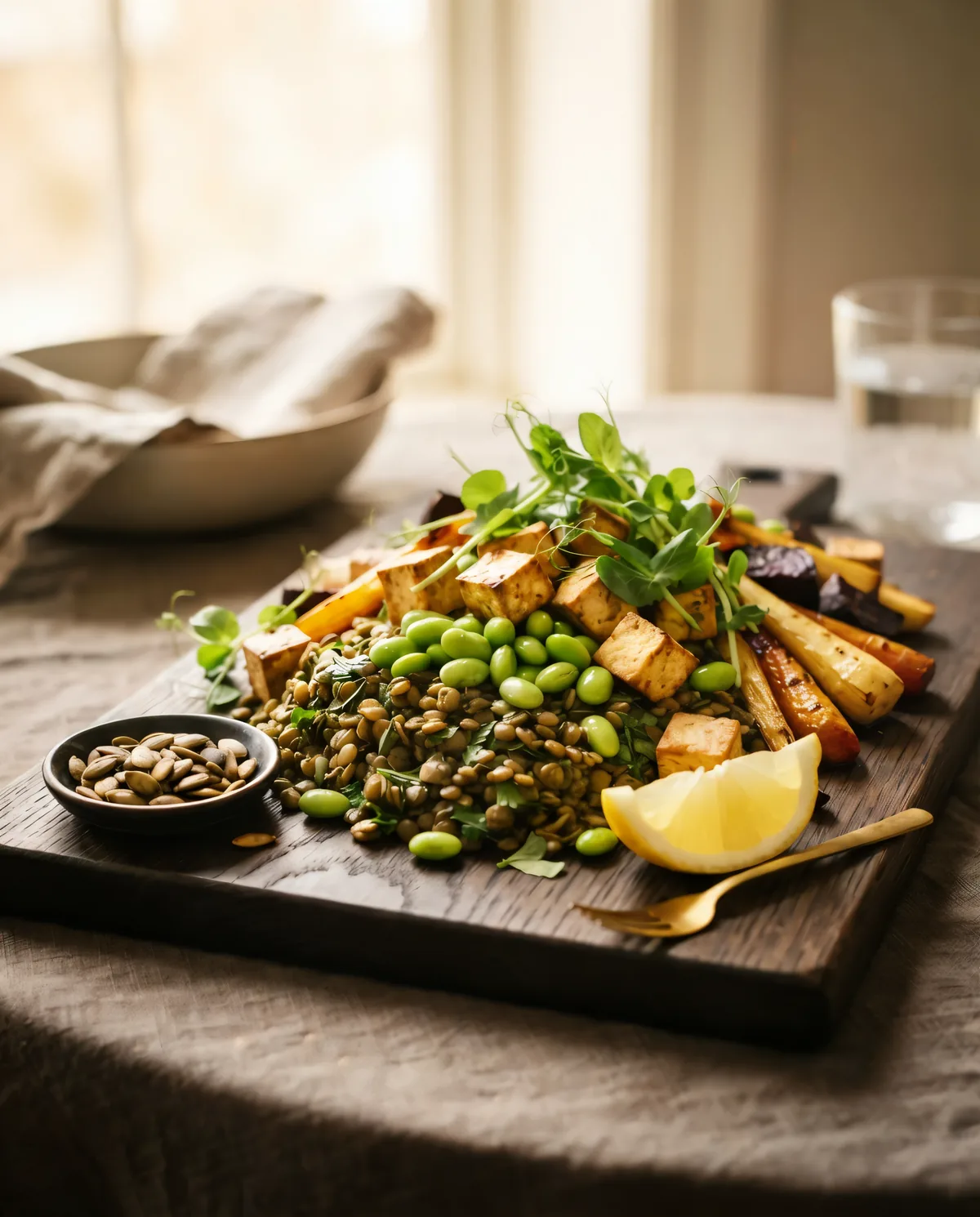
Vegetables are not where the protein comes from, and this list says so in its first line. A cooked cup of the best of them (edamame, which is a bean eaten as a vegetable) carries 17 g; a cooked cup of the vegetable most often praised for protein (broccoli) carries 4 g.
The useful question is not which vegetable has the most protein but which vegetables add 3 to 5 g to a plate that an anchor food has already taken to 25 g. That is the list below: fifteen vegetables ranked by protein per cooked cup, with the per 100 g figure beside it so the ranking survives a different portion size.
All figures are from the USDA FoodData Central database for the cooked food unless stated, rounded to one decimal. Edamame and lima beans are legumes eaten as vegetables; they are included because that is how people eat them, and flagged because that is why they win.
The ranking
| Rank | Vegetable | Per cooked cup | Per 100 g | Note |
|---|---|---|---|---|
| 1 | Edamame (green soybeans), 155 g | 17 g | 11 g | A legume; the only entry that can anchor a meal |
| 2 | Lima beans, 170 g | 12 g | 7 g | A legume; frozen is as good as fresh |
| 3 | Green peas, 160 g | 8.6 g | 5.4 g | Frozen peas are the cheapest 8 g in the shop |
| 4 | Potato, baked with skin, one large, 300 g | 7.5 g | 2.5 g | Low per 100 g; the portion is what carries it |
| 5 | Sweet corn, 164 g | 5.4 g | 3.3 g | Botanically a grain, sold as a vegetable |
| 6 | Spinach, 180 g | 5.3 g | 3.0 g | A cup cooked is about 300 g raw |
| 7 | Asparagus, 180 g | 4.3 g | 2.4 g | |
| 8 | Portobello mushrooms, grilled, 121 g | 4.0 g | 3.3 g | White button raw is 3.1 g per 100 g |
| 9 | Brussels sprouts, 156 g | 4.0 g | 2.6 g | |
| 10 | Sweet potato, baked, 200 g | 4.0 g | 2.0 g | |
| 11 | Avocado, one fruit, 200 g | 4.0 g | 2.0 g | A fruit by botany, a vegetable at the table |
| 12 | Broccoli, 156 g | 3.7 g | 2.4 g | Praised above its station |
| 13 | Artichoke, one medium, 120 g | 3.5 g | 2.9 g | |
| 14 | Kale, 130 g | 2.5 g | 1.9 g | Raw chopped is 0.6 g per cup |
| 15 | Cauliflower, 124 g | 2.3 g | 1.8 g |
Two things stand out. First, the ranking by cup and the ranking by 100 g disagree: potatoes and sweet potatoes climb on portion size, mushrooms and artichoke climb on density. Second, below rank 3 the numbers are all between 2 and 5 g per cup. Choosing broccoli over cauliflower for protein is choosing 1.4 g. Choose it for taste.
What a vegetable can do for your total
A plate with 200 g of vegetables adds 4 to 8 g of protein. Over three meals that is 12 to 24 g a day, which is real: about a fifth of a 100 g target. What a vegetable cannot do is replace the anchor. Reaching 30 g in a meal from broccoli alone would take 1.2 kg of it, which nobody has done twice.
The research on plant protein and muscle was not run on vegetables. In the Hevia-Larraín trial, 38 young men were fed 1.6 g of protein per kilo a day for twelve weeks of lifting, the plant-based group topped up with soy protein, and gained the same leg lean mass and strength as the omnivorous group; the plant diets in that study were built on legumes, grains, soy foods and nuts, with vegetables supplying volume. That is the pattern to copy.
Amino acids: where vegetables are quietly good
Most vegetables have an amino acid profile closer to legumes than to grains: reasonably high in lysine, the amino acid grains run short of, and lower in methionine. Spinach, broccoli, peas and potatoes all carry lysine at a usable share of their protein. In the Gorissen analysis of plant protein sources, the limiting amino acids in cereal proteins were lysine and in legume proteins methionine, with blends of the two covering each other; vegetables sit on the legume side of that ledger. So a plate of seitan (wheat, low in lysine) with a cup of peas and a potato is better balanced than the seitan alone, and not by accident.
Leucine, the amino acid that most directly triggers muscle protein synthesis, is the one vegetables are poorest in by quantity: a cup of cooked spinach carries about 0.4 g against a target in the literature of about 2.5 to 3 g per meal. The anchor supplies the leucine; the vegetable supplies the lysine, the fiber, the potassium and the plate.
How to use the list
- Frozen peas and frozen edamame are the two to keep in the freezer. Between them they add 8 to 17 g to any plate in five minutes.
- Potatoes with skin are a protein food if you eat enough of them. A 300 g baked potato with 150 g of lentils is a 26 g dinner.
- Mushrooms are the stealth entry. 150 g of portobello in a ragu is 5 g, and they carry the umami that makes seitan taste like dinner.
- Do not eat spinach for protein. Eat it for iron, folate and because it wilts into anything; the 5 g is a bonus.
- Stop counting broccoli. It is a fine vegetable with 2.4 g per 100 g. The number on a well-known protein-ranking site is per calorie, which flatters any food that is mostly water.
What the research says
- Hevia-Larraín and colleagues, Sports Medicine, 2021, randomised trial of 38 untrained young men (19 habitual vegans, 19 omnivores) lifting for 12 weeks at 1.6 g protein per kilo a day: no difference in leg lean mass or strength gains between a high-protein plant-based diet and a protein-matched omnivorous one. The contrary finding: young men, a high protein intake, soy protein top-ups; it does not test a diet built on vegetables. doi.org/10.1007/s40279-021-01434-9
- Gorissen and colleagues, Amino Acids, 2018, laboratory analysis of the amino acid composition of 35 commercially available plant and animal protein isolates: plant proteins had lower essential amino acid content (on average 26 percent of protein against 37 percent in dairy and egg), with lysine limiting in cereals and methionine in legumes; leucine ranged from about 6 to 9 percent in plant sources against about 11 percent in whey. The contrary finding: it analyzed isolates, not whole vegetables or mixed meals, and composition is not the same as the muscle response. doi.org/10.1007/s00726-018-2640-5
- Mamerow and colleagues, The Journal of Nutrition, 2014, randomised crossover trial in 8 adults: an even spread of 90 g of protein over three meals produced about 25 percent higher 24-hour muscle protein synthesis than a dinner-heavy spread over 7 days. The contrary finding: eight participants, one week, synthesis rather than muscle gained. doi.org/10.3945/jn.113.185280
Questions people ask
Is broccoli really 30 percent protein? By calories, roughly, because it has almost none of either. By weight it is 2.4 percent protein. The second number is the one that fills a plate.
Does cooking destroy the protein in vegetables? No. Cooking changes the volume (spinach loses nine tenths of it) and that is why a cup cooked carries far more than a cup raw. The protein itself survives boiling, steaming and roasting.
Are peas a vegetable or a legume? Both, depending on whether you ask a botanist or a cook. Green garden peas eaten fresh or frozen are counted as a vegetable in dietary guidelines; dried split peas are counted as a legume. Same plant, different stage.
What about seaweed and spirulina? Spirulina is about 57 g of protein per 100 g dry, which sounds enormous until you see that a serving is 7 g, carrying 4 g of protein. It is a garnish with a good number, not an anchor.